Percussion Loops for Church: Add Shakers, Congas & More to Your Worship Sound
Most worship teams don't have a percussionist — but percussion is exactly what separates "we played the song" from "the room moved." Here's how to add it without adding a musician.
Listen closely to any worship recording your congregation loves and you'll hear a layer most church bands can't reproduce: the shaker driving sixteenth notes under the verse, congas answering the drum kit in the chorus, a triangle or bell shimmering over the bridge. None of it is loud. All of it is felt. Take it away and the song still works — it just sits down instead of moving. Percussion is the motion layer of a worship arrangement, and it's the layer most teams are missing.
What percussion actually adds to a worship arrangement
Each family of percussion does a different job, and knowing the jobs is more useful than owning the instruments:
-
Shakers and cabasa — motion in the verses. A steady shaker pattern keeps energy flowing when the drummer drops to a simple groove or cross-stick. It's the difference between a verse that breathes and a verse that stalls.
-
Congas and bongos — lift in the choruses and praise breaks. Hand drums add syncopation the kit can't cover on its own. When the chorus hits and the congas come in, the arrangement steps up a gear without anyone playing louder.
-
Bells, chimes, triangle and gongs — texture and transitions. These mark moments: a chime swell into the bridge, a triangle pattern brightening a final chorus, a gong under a big ending. They're seasoning, not the meal.
The catch is obvious: a real percussionist is a whole extra musician — another set of hands to schedule, another monitor mix, another person to rehearse. Most churches have a drummer at best. A dedicated percussionist is a luxury even many large teams go without, which is exactly why percussion loops exist.
Arrangement rules that keep loops sounding musical
Percussion loops go wrong the same way live percussion goes wrong: everything playing all the time. A few rules keep it tasteful:
-
Less is more. If every element plays from bar one, you have nowhere to go. Congas hitting in verse one steal the lift they were supposed to give the chorus.
-
Build across the song. A simple arc works for almost any worship song: shaker only in verse one, add bongos in the first chorus, bring in congas and bells for the final choruses. Each section should add one thing, not five.
-
Leave the down moments alone. In a reflective bridge or a spontaneous worship moment, pull percussion out entirely. Its return is an arrangement tool in itself.
-
Percussion supports the drummer, never fights them. If the kit is busy, the percussion should be simple — and vice versa. This is true whether the percussion is a person or a loop.
Follow those four rules with any loop source and you'll sound like a team with a percussionist who listens — which is better than many teams with an actual percussionist who doesn't.
Doing it in LiveTrackz: a percussion section you can mix
The problem with most percussion loops is that they're a single stereo file — one shaker-plus-conga blob you can't change. LiveTrackz takes a different approach: every loop opens in a multitrack mixer with a dedicated channel per element — Master, Click, Clav, Triangle, Shakers, Bell, Gong, Chime, Bongo and Conga — so you shape the percussion around your team instead of playing over a fixed recording.
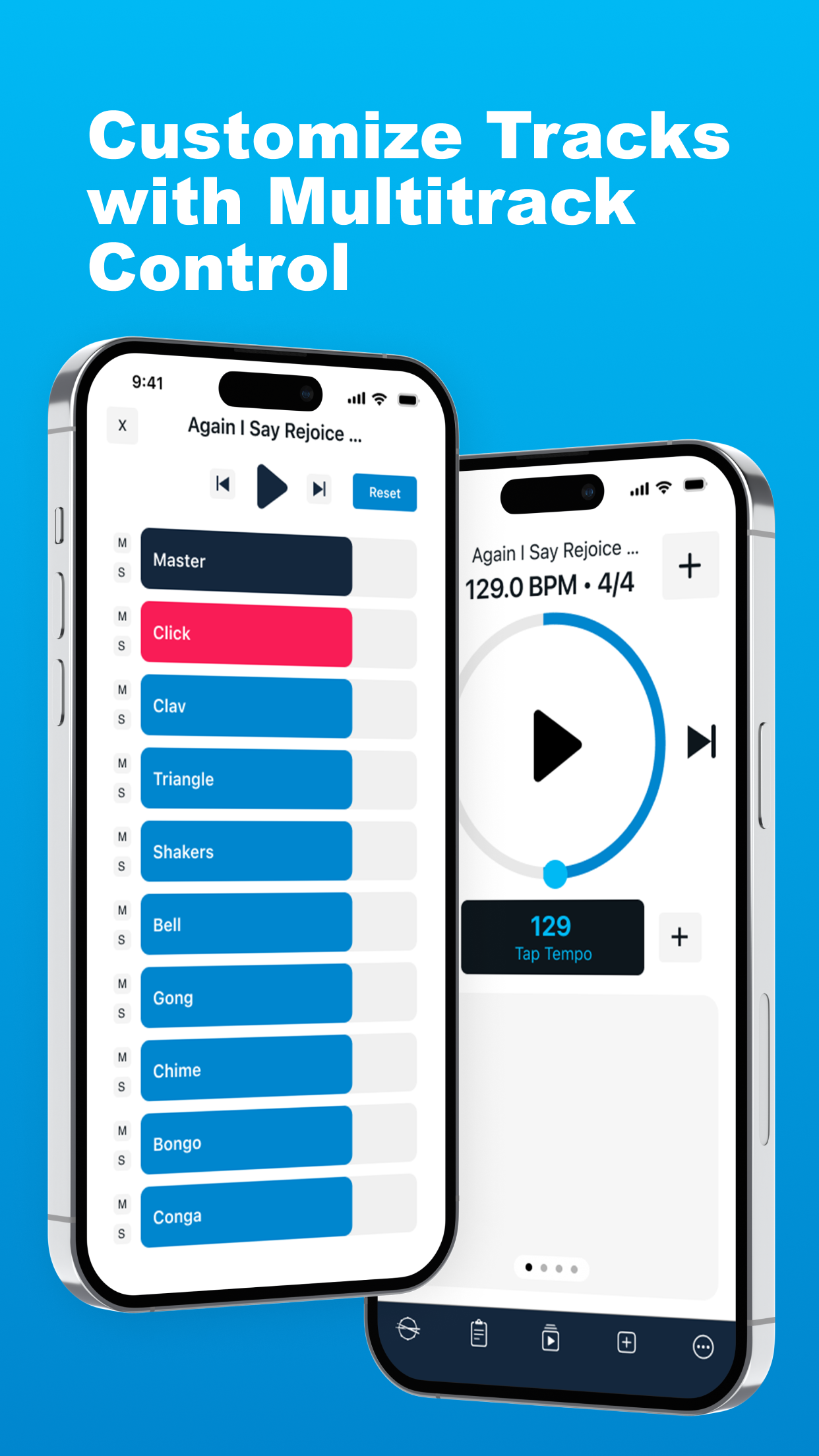
Multitrack control in LiveTrackz: individual levels for every percussion element, locked to 129 BPM in 4/4.
In practice that means:
-
Set individual levels for your room. Push the shakers up in a dry room that needs motion; pull the bells back if they're washing out the vocals. Every element has its own fader.
-
Mute what a live player covers. Got a real conga player this Sunday? Mute the Conga channel and keep the shakers and chimes running. When they're away, unmute and the arrangement doesn't change.
-
The loop follows your BPM and time signature. Every loop is tagged with tempo and time signature, so the percussion locks to the same click your drummer hears — the same timing reference that keeps gospel drum loops tight works for shakers and congas too.
-
It works live, from your phone. Tap to start, get the count-off, and the percussion enters exactly on the programmed tempo — no laptop side-stage. If you're new to running tracks on Sunday, start with our guide to using backing tracks in live worship.
Tip: At rehearsal, solo your way through the percussion channels once so the team hears what each element is doing. Bands play better with a loop they understand — and your drummer will start leaving space for the congas on purpose.
Getting started this week
-
Install LiveTrackz on an iPhone or iPad (iOS 15+)
-
Pick one up-tempo song from Sunday's set and find its loop in the 3000+ library — search by title or browse the Gospel category
-
Open multitrack control and build a simple arc: shakers up, congas down for the verses, then plan where the lift comes in
-
Run it at rehearsal with the click in the drummer's in-ears, and adjust levels for your room
One song, one shaker pattern, one lifted chorus. That's all it takes for your team to hear the difference — and for the congregation to feel it.
Add a percussion section to your team this Sunday
LiveTrackz is free to download, with 3000+ loops and per-element multitrack control — shakers, congas, bells and more, all mixable from your iPhone.